
Gary Fisher – “Father of the Mountain Bike” – Still Riding in Style

At age 75, Gary Fisher is still fighting fit, riding regularly and spinning yarns.
Although the prestigious Smithsonian Magazine named Gary Fisher the “Father of the Mountain Bike”, and Fisher was certainly a key player at its birthplace, in reality there was no single inventor of the mountain bike. It was gradually developed by a bunch of Marin County, California hippies during the 1970’s.
Gary Fisher certainly fitted the hippie description. He was thrown out of the conservative world of road racing in 1968 because he broke a rule that stipulated competitors have short hair – hard to believe, but true.
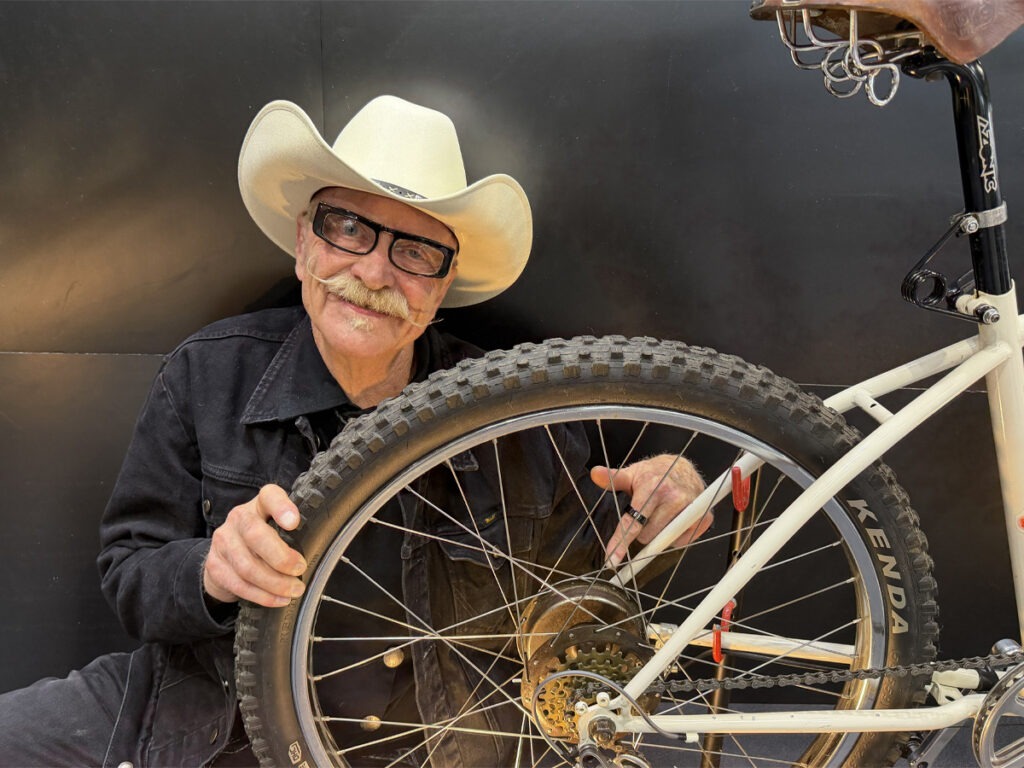
Right through to this day, Gary takes great pleasure in standing out from the crowd, for many years dressing for public occasions as a “dandy” with all sorts of bright colours and extravagant costume. But the day I spoke with him at Taipei Cycle, Gary was dressed in more conservative 1800’s Wild West attire.
As always, his trademark handlebar moustache gave you absolutely no doubt who this tall, loud, frequently laughing American was as he posed for photos and gave autographs to a steady stream of admirers.
It was Fisher who first coined the term “Mountain Bike” in 1979, the same year that he and his roommate Charlie Kelly founded MountainBikes, the world’s first dedicated mountain bike manufacturing company.
Their frames built by another Mountain Biking Hall of Fame member, who like Fisher, came from road racing, Tom Ritchey. MountainBikes made a grand total of 160 mountain bikes in their first year.
After just four years, MountainBikes was dissolved in 1983. Gary quickly went on to bigger and better things, founding Gary Fisher Mountain Bikes that same year. Through this brand, he would be a major player in the booming new mountain bike industry for many years to come.
Amongst many firsts, Gary Fisher Mountain Bikes produced the first full commercially available full suspension mountain bike with a four bar linkage rear suspension, designed by former champion motorcycle racer Mert Lawwill.
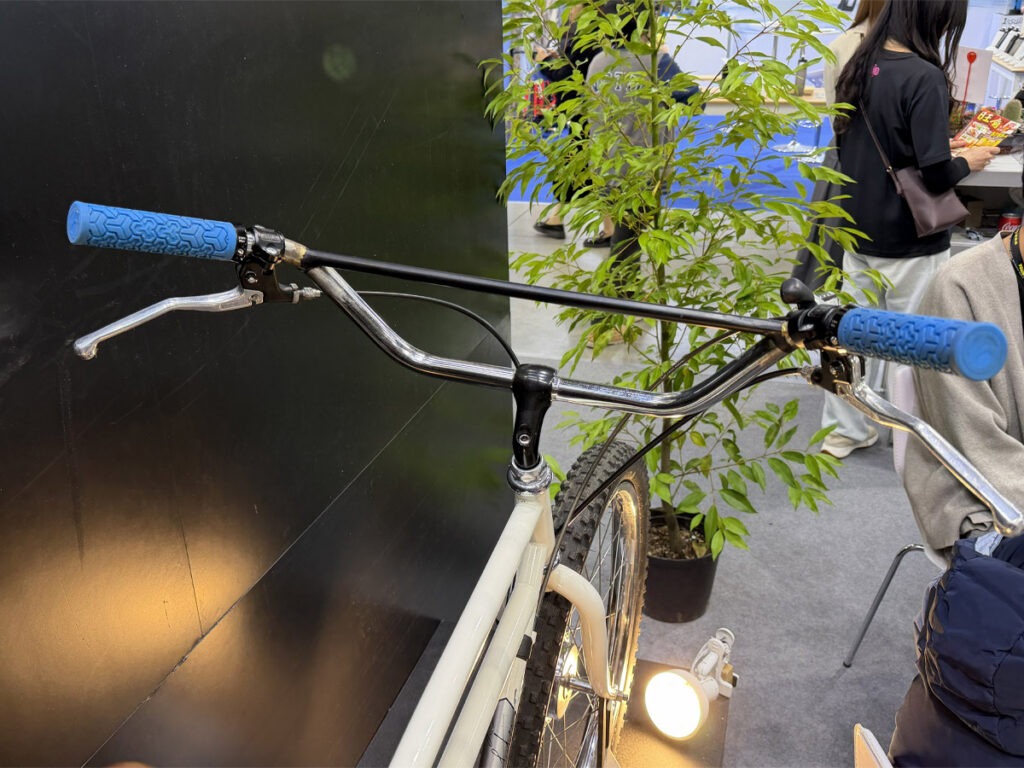
Those huge brake levers are from a motorcycle.
After a decade, Gary sold his business and brand to the Trek Bicycle Corporation. Both were privately owned, so no financial details were ever publicly disclosed, but it was a big deal at the time. Gary stayed on as a brand ambassador, designer and mentor to their many high profile athletes including Women’s World Champion, Paola Pezzo.
Gary was an inaugural inductee into the Mountain Biking Hall of Fame in 1988 and has been publicly championing the cause of not just mountain biking but cycling advocacy and kids riding, to this day.
This was not the first time I’ve interviewed Gary Fisher, so I knew what to expect. Stemming from his deeply rooted family connections to Hollywood, Gary loves a stage upon which to perform.
Like an early mountain bike perched at the top of the famous Repack downhill course, Gary is easy to get rolling, quick to gather momentum, but hard to stop! Although quite frequently, he’d take a break to let out a hearty laugh at any of his comments that particularly took his fancy.
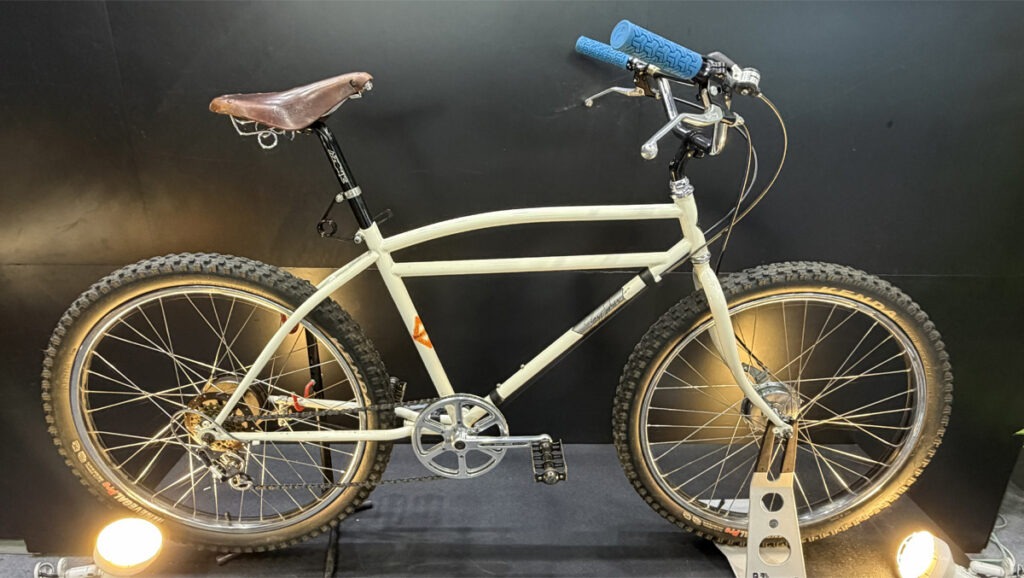
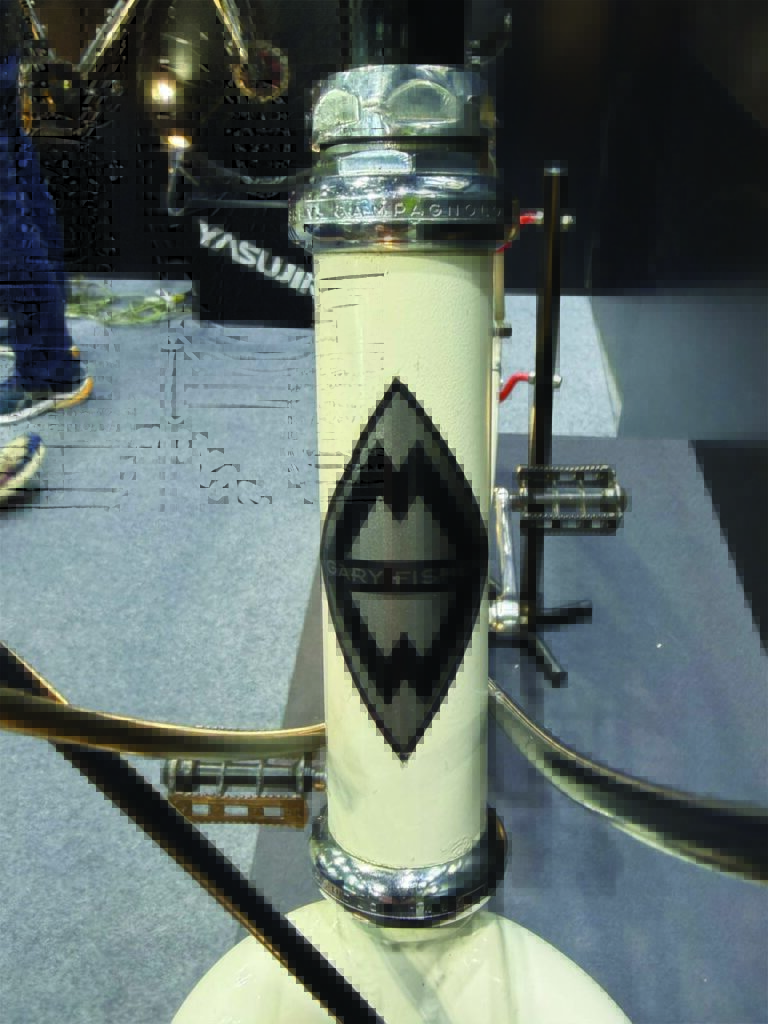
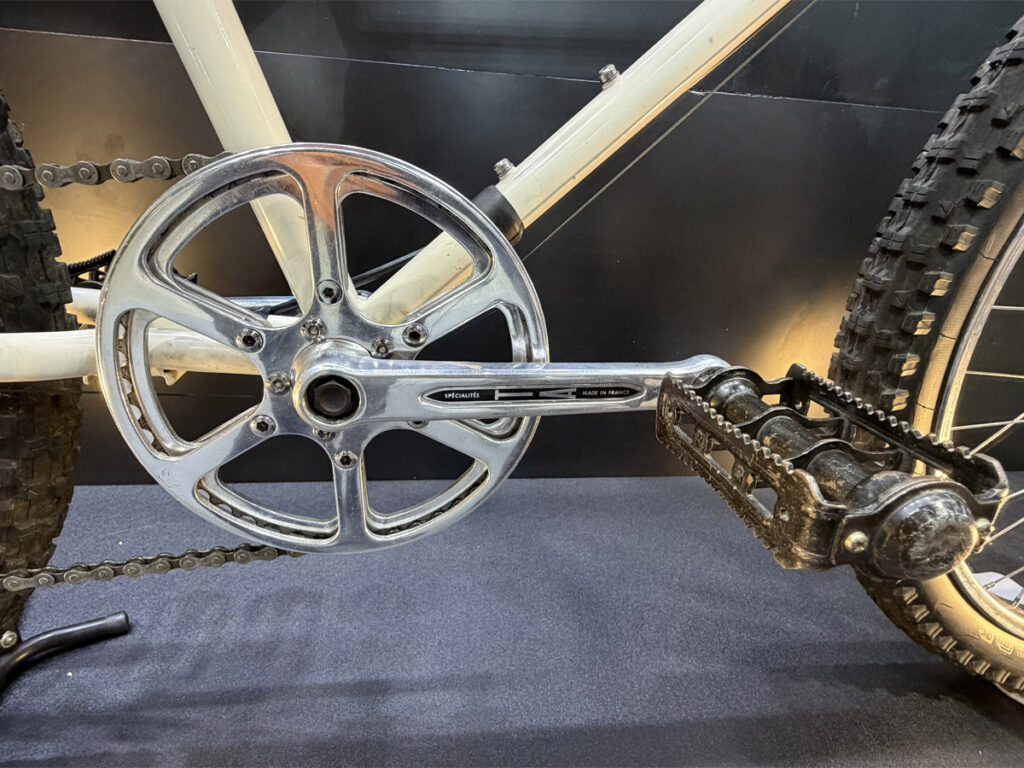
We were speaking on the Tange Yasujiro stand in the heart of one of Taipei Cycle’s exhibit halls. They had one of Gary’s original mountain bikes on display along with some photos and of course promotional postcards ready for the man himself to autograph for visitors, along with obliging for selfies.
Listening to Gary Fisher is certainly never dull! He’s a great storyteller. Here’s what he had to say…
Historic Display Bike
“We started making bikes like this in the mid-1970’s, Gary said, in talking about his personal bike that was on display.
“It was myself, Doug White from White Industries. He was right there man! Making bikes he called the Paper Clip and stuff. He was making bikes for people in 26 inch and for himself he made frame with 20 inch wheels front and rear, because there was a 20 inch wheel you could get in alloy.
“It was the BMX guys in Southern California who brought in Araya and Ukai alloy rims.
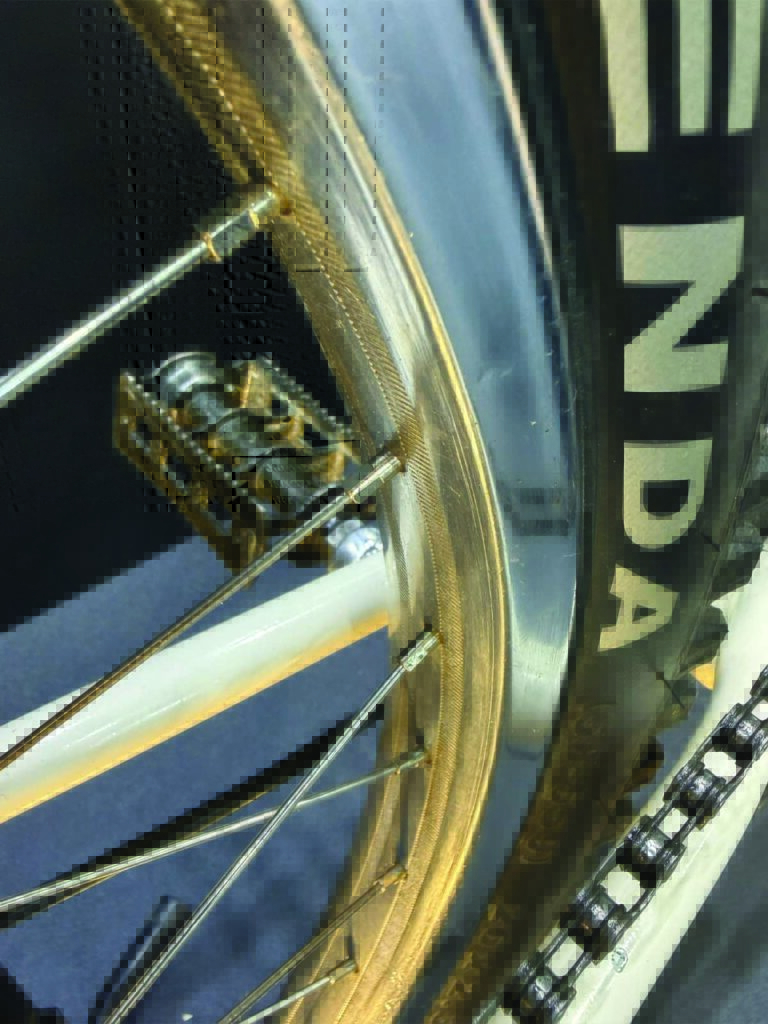
These rims here are Schwinn steel S2 rims. They weigh about 50, five zero, ounces… each!” he exclaimed, laughing loudly.
That’s 1,417 grams each, about triple the weight of modern enduro or downhill rims.
Gary resumed, “And they’re pretty mild steel. If you ran about 20psi on this bike and you hit a big enough rock… man! You put a big enough dent in that rim so the inner tube would start poking out. You’d grab another rock and pound it back together!” After recovering from more laughter he summarised, “It was primitive!”
“And to use cantilever brakes… (an early form of rim brake used on some road and cyclocross bikes of that era), that was a bad bet, because the minute it got wet you were… there were no brakes!” Gary laughed heartily yet again at this recollection.
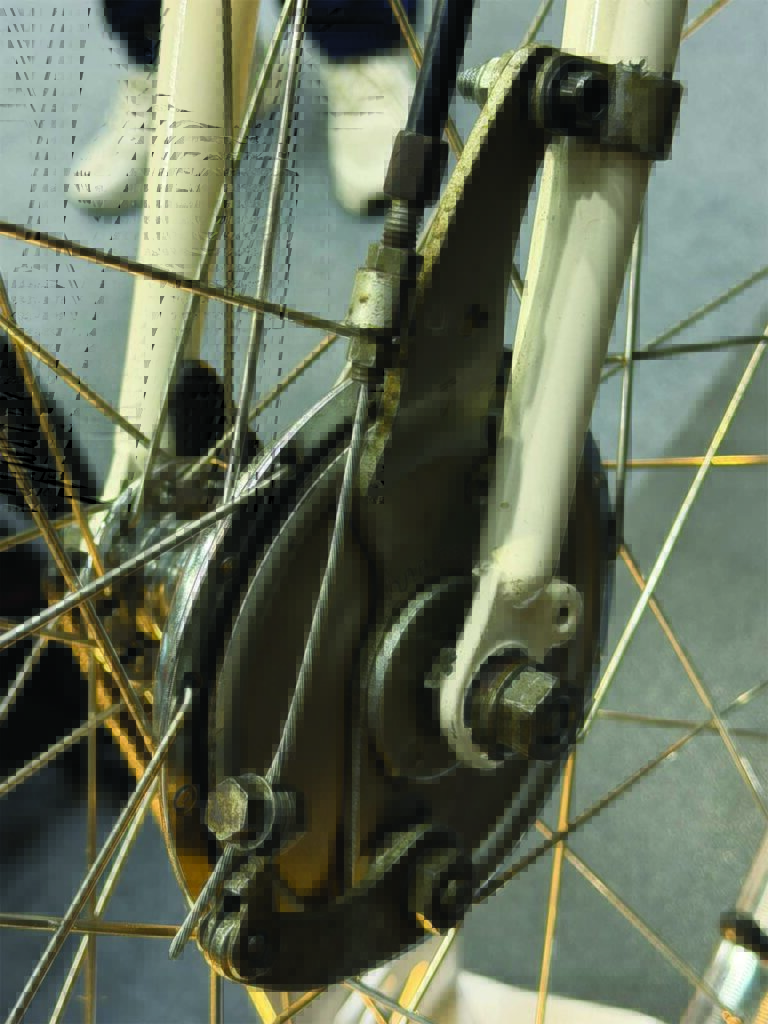
“So we used these drum brakes. The brakes really worked… they’re not light, but they worked. And the alternative was to use a cantilever brake on a chrome plated steel rim… forget about it!
“We’d scrounge them. This front drum brake is a Union from Germany that came on a Schwinn Twin Tandem. We’d search old bike shops and look for that gold.
“That was the problem. At the beginning of this whole scene, it was like a scavenger hunt – putting together all of this old oddball stuff that wasn’t supposed to be put together.
“I did Pearl Pass on this bike. I think about 12,000 feet of elevation man!”
Pearl Pass is a steep, rough dirt track, closed throughout the winter due to snow, that reaches 12,723 feet (3,878 metres) in altitude and links Crested Bute with Aspen in the Rocky Mountains of Colorado, USA.
Recalling the Birth of Mountain Biking
Next Gary recalled his early years and lived experiences as part of the birth of mountain biking as a culture.
“The whole scene in Marin County just started going off,” he recalled. “The first time I saw that off road scene, I was in high school and there was a group that called themselves the Larkspur Canyon Gang. They used to just go out and have fun on their bikes.”
Then, confusing me for being British rather than Australian, Gary gave a brief pronunciation lesson. “Marin County… the Brits all say “MAR-in” but we say “ma-RIN.”
“They used to do drum circles – conga drums, a whole circle of them – I mean I swear to God they invented that thing in the mid-sixties. All these kids went to Redwood High School.
“Marin County had a huge amount of outdoor space. So the hippies would go out and camp there. Then the water authorities started putting up chains, gates and things.” (This stopped cars that some of the groups were using for access). “So, you’d bring a bike in.”

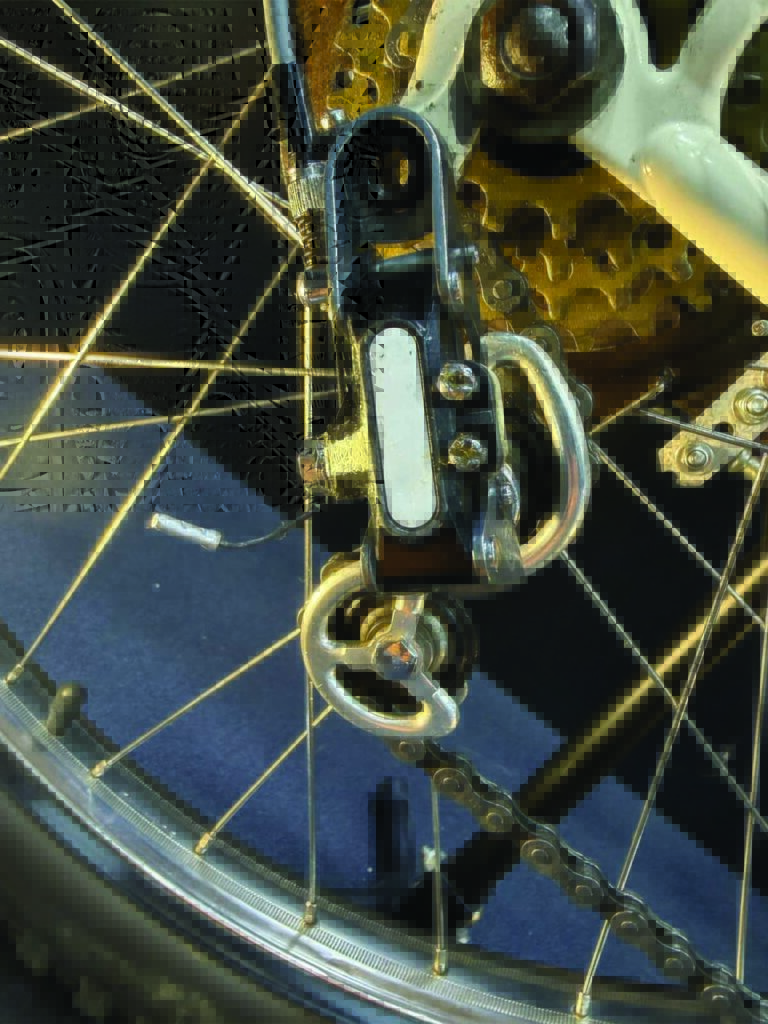
This old system is inferior to modern day cassettes in just about every way! Heaver, less capacity for large gears, less durable, and mechanically weaker.
“And it was like this incredible space with noooobody!” he exclaimed. “Except you.
“In the mid-sixties, very few people hiked. Very few people went into the outdoors. Man, it was like our circus playground!
“Another thing these guys would do was called “Derby Night”. They’d find a big open patch where a few fire roads would come together, and you’d start the derby with “cocktail hour.”
“Somebody would bring a lot of beer. You’d have a beer in one hand and be riding around. Then you’d get into serious derbying after that where you’d go in front of somebody and stop them and force them to put them to put their foot down.
“It would end up with a bike pile. All the bikes would be stacked up on each other and then you’d drag your poor bike out.
“Usually this was done on moonlight nights because… I’ll tell you man, the bike lights were horrible back then! You had these generator lights and everybody would use these Wonder Lights and man, they were so weak and the battery would go out.
“So moonlight nights were the best! He said, pausing for another loud laugh. “And that was the culture.”
Developing the First True Mountain Bikes
Unlike many of his other hippy friends in the early Larkspur Canyon Gang scene, the cycling element of this grass roots cultural happening was more central to Gary’s life. This, combined with a strong mechanical and design aptitude and entrepreneurial spirit saw him quickly rise to the forefront of developing the first true mountain bikes.
As is often the case, the new invention was mainly motivated by existing products not being up to the task.
“I was a road racer since I was 12 and they said, “Hey, you’re a serious biker! You’ve got to come and check this out.” So I went out and did it. I’d had a cross bike – I’d done cyclocross. But you take that bike out into the woods and there were so many sharp rocks that you’d spend two hours on a ride and three hours patching tyres!” he recalled.
“My original tyre was a 26 x 2.125 Uniroyal Mave that you could buy at any bike shop in the United States for US$11.99. So that was the tyre of choice. I mean, I was riding Clement silks at the time – Clement 250 and Del Mondo. Most of those tyres were 23 mm and 25 mm – they didn’t like rocks!” he said laughing loudly.
Most readers may not be familiar with these expensive, lightweight, handmade Italian tyres. But Gary’s comments immediately gave me nostalgic memories of spending a huge proportion of my meagre income buying Clement tyres. They were “sew up” or “singles” tyres for road and velodrome riding that were glued to purpose designed compatible rims. They had a lightweight tube inside a sewn up silk fabric carcass and a super light, thin tyre tread.
Gary resumed, “But with these Uniroyals you could just rip it down the hill, as fast as you wanted. But the brakes were horrible. The original set up was a single speed with a rear coaster brake. It would overheat and literally smoke would come out. All the grease would disappear and it was useless!
“So we had to use this technique – you’d be on-off, on-off with the brake. You’d lock it up and since there was either a real ineffectual front brake or no front brake, you’d have to turn the bike sideways (into a slide to slow down) or you were a goner!” he exclaimed with yet more loud guffaws.
“It was hilarious! I upset everybody at the beginning by putting gears on my bike and putting a brake set up that I knew would work – that was drum brakes. Then everybody started doing that for a while and it became really difficult to find the parts.
“But my roommate Charlie was a roadie for a rock band and they’d go all over the west of the United States. “Any time they were in a town he’d look up the oldest bike shop and go through their pile to see what was there. But it was a finite amount.
“So finally, I was at the Olympic Training Centre. I was on the B team… the A team sometimes. I was right on the edge of going to the Olympics, but in 1979 we (the USA government) said, “Guess what? We’re not going.””
Gary was referring to the USA boycott of the 1980 Moscow Olympics due to Russia’s invasion of Afghanistan.
“So at that moment… you know I wasn’t the favourite of the coach at all. He would call me a “lousy groovy”. He was from Poland – Eddy Borysewicz.”
“Eddie B” as he was commonly known was a famous USA coach, but a renowned Eastern European style disciplinarian who was later involved in a blood doping scandal.
Gary resumed, “You had to be chosen to be on the team and then you’re going to win the race only if you’re the chosen one, you know, the captain of the team. So I thought, “I’ve had my day here. It’s time to start the bike company.”
“I’d been thinking about that for a while. We’d take out people (on the Marin County trails) and their eyes would come back… “I loved it!”
“That was it. I knew… you know I made a video that went nationwide and won an award. It was about the Repack Race.”
Repack was the world’s first organised MTB race, that ran annually from 1976 to 1979. Gary Fisher holds the Repack course record.
Gary continued, “I gave the quote, “This has come a long ways and it’s going to go a long ways.”
“They asked me, “Where did this come from?”
“And I said, “Look, over 100 years ago, we all rode off road. There were no paved roads.”
“They said, “What about gears?” and I said, “Oh that’s only about five years away.””
This prediction proved to be about right, with the first fully-developed, MTB-specific groupset, Shimano’s Deore XT, being introduced in late 1982 and becoming widely available from 1983.
Gary could clearly see the opportunities for future development of both the mountain bike and the sport of mountain biking.
“I knew it!” he said. “So I had this opportunity. I quit road racing and said, “I’m going to start a company.”
“I started it with my roommate, (Charlie Kelly) which was a mistake! We had 600 bucks. I paid a $500 deposit on a bike and I could float a check, sent via UPS, COD (cash on delivery) for 10 days. It was illegal, but man it kept me going. I never bounced a cheque.
“The first guy I hired was a bookkeeper. I had like, 10 people building wheels. I had a frame builder (Tom Ritchey), three different frame painters. I bought all the parts.

“I was good at it because I had been working for Bicycling Magazine as their first road tester. So I met everybody in the industry. And some of them really helped me! Like Neil Todrys from Todson.” (Neil owned this major USA bike distribution business, founded by his grandfather in 1939.)
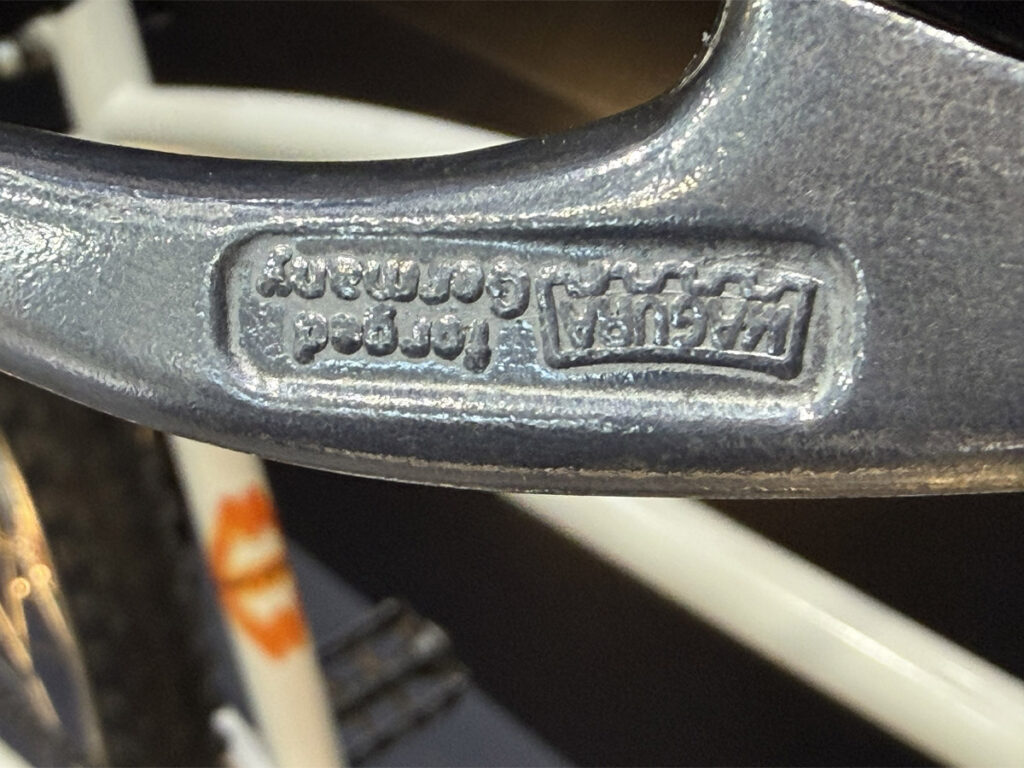
“Neil gave me a $10,000 line of credit. I had no credit rating! Magura… $10,000 line of credit. John Finley Scott (another MTB pioneer and Mountain Biking Hall of Fame member)… $10,000 worth of cash.
“I paid everybody back. They really helped me with the whole thing.
“A few people really got it. The southern California BMX guys… oh man, they got it! They understood what the attraction was, and they really helped grow the whole thing.
“And then the big guys got in. It’s funny… Mike Sinyard (founder of Specialized Bicycles)… I sold him four bikes. I knew he was going to copy them, and he did!
“I’d go down to his office and buy things from him when I couldn’t get them any cheaper. He’d give me a good deal.”
Specialized started as a parts and accessories importing and sales company years before the sold their first Specialized branded bicycle.
Gary continued, “So I’m down there and he says, “Hey Gary, I want to show you something. Do you want to buy some of these things?” And man, he copied it right down to the paint colour – everything!
“What do you expect? If something is good, of course people are going to copy it!”
“Then the whole thing happened. Myself, Mike Sinyard, Ben Lowey from Univega and Randy Ross from Ross bicycles all went to the Japanese and said, “Man, this is happening… get on board!” And what the Japanese did is make equipment, bikes and marketing money.”
Gary’s links with Japanese suppliers remain in place to this day, including his appearance on a Japanese stand at Taipei Cycle.
Marketing and Showmanship in his Blood
Part of the reason for Gary Fisher’s prominence in the early mountain biking scene is his deep sense of showmanship and his ability to attract public attention. It turns out that this goes back through his family line, as he explained.
“The thing about it was that I knew how to do marketing because my grandfather worked in Hollywood. Straight out of high school he went to work for Hal B. Wallace (a legendary Hollywood producer of many movie classics). Then he worked for Warner Brothers for 40 years and he did publicity for 400 movies.
“When I was a kid he would bring people like Ronald Regan, Joan Crawford and Errol Flynn to our house. I thought these were just normal people.
“My grandfather would lecture me on, “This is how you stand. This is how you speak. This is what you do…” and it served me well!” Gary said with pride and emotion.
After Gary started his bicycle company, his movie industry and professional singing mother would also give helpful advice.
“My mother would be like, “Gary, you need a better photographer! We’re going to throw that in the round file.” (rubbish bin) “Gary, you need a better writer!”
“Damn straight if I didn’t get that. We had a big, long publicity list and we’d do mailings all the time. And man, we got press! Mainstream press. Not just bicycle press, mainstream press!
“That’s the problem we’ve got today man. People are marketing straight to the people who already have bikes. We’re targeting everybody that has bikes already and that’s a bad thing!
“We’re not going after the general public, so we’re not going to draw in the general public as much.
“I got in the German Bild Magazine. I got in the New York Times. CBC (a major USA TV network) did a whole story on it. Because I’m a great presenter – I learned that from my grandfather. He created what’s called American Broadcast English.”
When Gary was young, his mother remarried Robert Fisher, a prominent architect and moved from Los Angeles to the San Francisco Bay Area.
“Man, he was smart,” Gary recalled. “And great at photography. He did a tonne of cycling photography. You should see these shots!”
Parting Thoughts from Gary on Today’s Cycling Scene
I asked Gary about today’s cycling scene and is attention immediately turned to e-mountain bikes and Fat Bikes.
Firstly, regarding e-mountain bikes…
“They’re a lot of fun! But I like riding acoustic bikes. They’re simple. I’m still riding. Oh yeah! How do you think I stay healthy?
“Don’t ever forget this… What are we selling? Health and happiness man!
“Riding a bike helps you forget and it helps you remember. Your wife says, “You’re twitchy. Go ride your bike!” And it works. Seriously!
“But e-mountain bikes, they’ve gotten out of hand. A little on the too powerful side. It’s crazy. This whole concept that DJI did using software (to boost the bike’s power), it’s a little too much.”
With that thought Gary segued into Fat Bikes…
“But it’s funny – e-bikes for kids – that whole thing with Super73 – all these big fat tyres and things – they’re really good for kids.
“The regular, traditional biker says, “Urrghh… that’s not a bike! But you know what’s happening? They’re (teenage kids) learning how to ride two wheels.
“But this is even more important. I’ve talked to our Chief of Police and asked him, “What do you think? Is this out of hand?”
“He said, “Yeah, but if I start cracking down on these kids, the mums are going to kill me! Because that saves the mum a trip every time!”
Gary continued, “And you know how the traffic is. It’s horrible! And anyone who goes on a bike shows up on time, but anyone in a car… it’s totally unpredictable.
“I mean these guys (kids on fat bikes) have got their own responsibility, so I think that’s a great thing. But consequentially, we’ve got to become much more serious about safe bike routes.
“We’re even doing a series of trails that go parallel to different locations. They go to the schools so that the kids don’t have to deal with the traffic and they don’t compete with the traffic,” he explained, referring to his home area of Marin County, California.
“I live in a really wealthy area called Belvedere (part of Marin County). 25% of our kids ride or walk to school.” (Well above the USA average of 11.1%).
At 75 years of age, it was great to see that Gary Fisher was so full of energy and enthusiasm. Even half a century on from being at the forefront of creating the mountain bike Gary correctly understands that he was part of a significant turning point, not just in bike industry history, but an invention that has changed the world and many people’s lives for the better.
just tuned up my all original 1990 Ibis and it sure brings back memories of my days in Marin. The folks that tuned and cleaned it flipped out.