Will Australia’s E-Bike Regulations Ever be Fit for Purpose?

Welcome to the messy, piecemeal and sometimes contradictory labyrinth of rules and regulations that currently “govern” the importation, sale and use of e-bikes in Australia.
There are a lot of unhappy Australians at the moment when it comes to regulations for e-bikes in general and fat bikes in particular.
The bicycle industry is not happy that New South Wales has completely botched the implementation of electrical safety regulations that have not only caused financial pain for wholesalers and retailers, but reduced the range of choice of perfectly safe models for consumers.
In Queensland, consumers, the bike industry and a range of health and welfare not for profits are gearing up for a fight with the car-brained government who have decided that it’s a good idea for all e-bike riders to not only be over 16 years of age, but worse still, to have a current driver’s licence or at least learner’s permit. This would totally penalise the huge cohort of people, who for a wide range of reasons, either choose not to or cannot drive a car.
Large sections of the community, especially older people such as retirees in coastal cities are unhappy because riders of fat bikes, often young, sometimes in large groups, are flying past them along shared coastal pedestrian and cycle paths at speeds way beyond the “legal” e-bike standard of 25 kph.
The State and Territory governments are not happy with the federal government showing a distinct lack of leadership on taking the national action that they’re pleading for. In particular, Federal Transport Minister Kathryn King appears to be completely disinterested and not bothered about understanding the problems or taking the issue seriously. She certainly appeared that way in her train wreck of an interview on this 60 Minutes program about e-bikes.
And understandably, most unhappy of all are the growing number of families grieving the loss of their often young family members who have died in a wide range of fat-bike crashes, while others lie in hospital in induced comas with serious head injuries and other major issues.
Not Everyone’s Unhappy
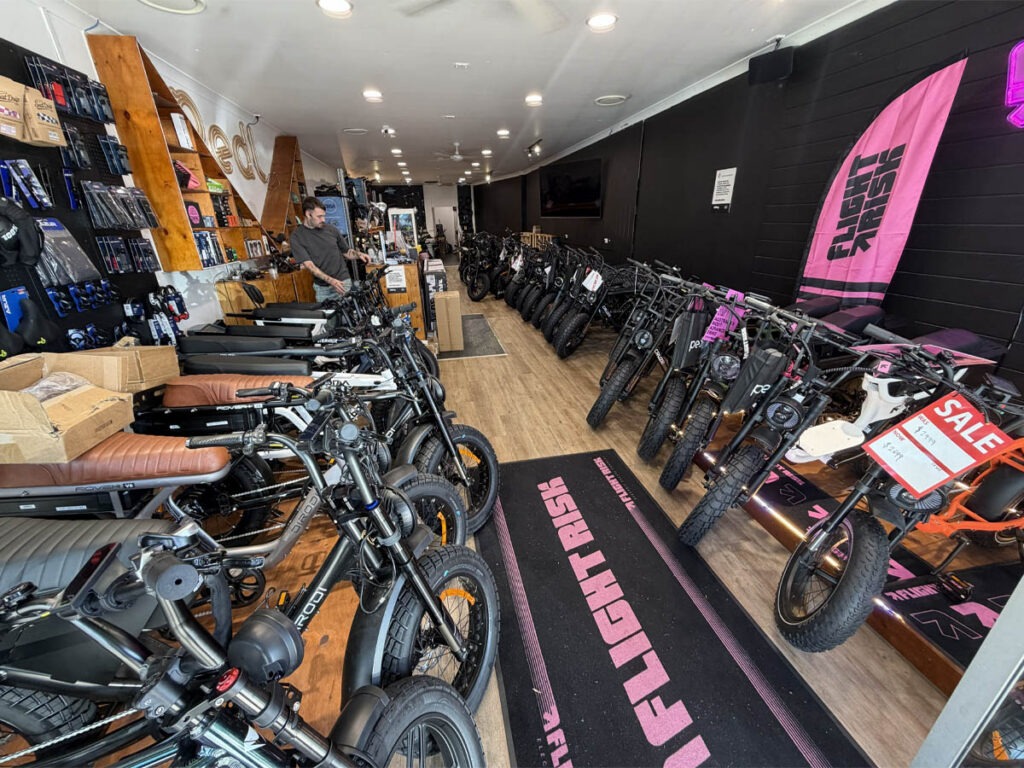
On the other hand, many people, especially teenagers, think that high powered fat bikes are great, evidenced by the thousands who keep buying them every month and the huge numbers that you can now see on the roads, paths and trails of every Australian city and town. They like having fun, adventure, taking risks and socialising with their peers.
Those who are making a profit in selling these bikes, are also smiling. Although one fatbike specialist retailer recently told me that business was down, in part because parents are becoming more wary that if they purchase a bike for their kids it might be confiscated and crushed by the police.
The thousands of low-paid, often immigrant or temporary visa’d delivery workers around Australia are happy that they don’t have to pedal throughout their long workdays and nights.
Many parents and grandparents who either can’t afford or choose not to buy more expensive standards-compliant e-cargo bikes, enjoy using fat bikes to take their kids to school or share adventures with young kids on the local paths during weekends. This particular user group generally tends to ride slowly and safely.
More than a few cycling and broader transport and environmental advocates think that fat bikes either a positive, or that at least they’re not all bad. In a time of oil shortages, leading to rising petrol prices, it’s quite likely that fat bike demand, along with the overall bike industry, will do well over the coming months.
Clearly, it’s a complex issue. In this article, I’m not going to wade in with opinions until the conclusion, but to focus upon interviews I had with two people who are both extremely closely involved, but have strongly differing perspectives.
A Fat Bike Importer’s Perspective
Ben Sterrey is the founder and owner of Ben Buckler Boards, a Sydney-based importer, wholesaler and retailer of a wide variety of adventure related products, including fat bikes.
“We sell Super73 fat tyre e-bikes,” Ben said. “They’re the original fat tyre e-bike from 10 years ago. We also do Serial 1 by Harley Davidson.
“The name Super73 comes from the 1973 oil crisis in America where all these cars were lining up for fuel, someone invented the mini “monkey bike” (a petrol powered mini motorcycle) to get around and save on fuel costs. The Super73 was designed after that style.”
I started by asking Ben about how his sales of fat bikes were going.
“Consumer demand has come off a bit after the NSW government announcements and policy changes,” he reported. “The February 1st Department of Fair Trading certification requirements also reduced sales because it created confusion.
“But Chris Minns (NSW Premier) and the NSW government are also talking about age restrictions and crushing e-bikes.”
Next I asked what Ben would like to see in terms of government involvement and regulation.
“It’s a great opportunity to continue encouraging the uptake of cycling, so they need to get behind all these new cyclists with support and education,” he said.
“To be fair, they created this problem in the first place by removing restrictions to vehicle entry in 2022.” (It was Jan 2021 to be exact) “That opened the floodgates to brands like Fatboy and Flight Risk. You can’t change the past. But they created the issue and now they’re trying to shut it down.
“I mean, Super73 has been around for 10 years. They (the government) had 10 years to put in place some structure and guidance for people.”
It seemed that Ben perceived his brand, Super73 as being different from brands like Flight Risk and Fatboy, so I asked him if it was any different in terms of throttle control or power specifications.
“Yes, because we’ve always had a street legal version of the bike,” he said.
Certainly, Super73 is heavily advertised on the Ben Buckler Boards website as being EN15194 compliant. But there’s a widely available Super73 app and only mode one of four available modes is compliant. The highest mode allows for 1,200 watts of throttle controlled, continuous power that will drive the bike at up to 50 kilometres per hour. These numbers are way beyond the EN15194 upper limits
Ben responded, “Oh well, that won’t be the case going forward because of the anti-tampering rule. So Super73 will be restricting the app, based upon what country they’re in,” Ben responded, although he agreed that the current app is still in place now.”
If all Super73 bikes will actually be restricted by the software, wouldn’t that put Ben at a competitive disadvantage compared to other fat bike importers?
He conceded, “Yes, it certainly will put us at a disadvantage,” he agreed. “So far, nine out of 10 customers want to be able to de-restrict their bike – purely for safety reasons because it’s safer to go at the same speed as the traffic around you.”
“But besides that, we do have a lot of customers on farms that have come to rely on our bikes, so removing the software functionality is disadvantaging farmers.”
It was hard to picture an Akubra, Dryzabone and RM Williams clad farmer getting around on the quintessentially cool California fashion statement fat bike so I asked what proportion of Super73’s customers were farmers.
“Probably 20%. Because they don’t have as much maintenance required as petrol-powered bikes and they’re not as loud so they’re not disturbing their animals as much.
“We don’t know what’s going to happen in Australia in the future. 2026 is a really interesting year. We know in America that when they did a rule change in January 2025, Super73 thought their business was over, but what they found was a new market – a law abiding citizen market – that filled the gap for them and they were able to continue selling e-bikes, street legal.
“We don’t know if this will happen in Australia because so far nine out of 10 bikes have been de-restricted by consumers. If you look at the BIA and who sponsors them, it appears that the BIA sponsors want to shut down the fat tyre bike industry, based upon what they’re doing and the lobbying for rule changes, lobbying for adjustable height seats. (Because fat bikes typically have fixed seats)
“That is an interesting experiment in itself, because I feel that their expectation is that once they’ve shut down the fat tyre e-bike industry, that they will sell more of their own brands, of Trek, Giant and Specialized. This is a very interesting high level question. If you own a business, can you sell more by shutting down the competition? And I think the answer is no. But I’d love to see the results of that.”
There is talk in several Australian states of also adopting the European S pedelec standard (for “speed pedelecs” that can offer power-assist up to 45 kph). These bikes are still quite different to the fat bikes we’re currently seeing in Australia, but I asked Ben if he’s keen on this higher speed variant also being approved here.
“Yes, we definitely want to do that,” he said, “because there’s no limit on the motor size. I’m not saying that they need a huge motor but I’m saying, “Let’s give us 1,000 or 2,000 watts so that we can continue carrying those people off the couch.” A lot of our customers are huge people, like 120 kilograms, right? They’re not going to move off the couch for 250 watts. But if you stick 1,000 or 2,000 watts under them, that will get them out and mobile and in the fresh air.
“It’s been so encouraging over the past years so see so many people adopting these e-bikes. If you look at the numbers, DiroDi do 12,000 fat tyre e-bikes per annum. Fatboy – they’re about 20,000 per annum. Crewzer do about 4,000 per annum. Those numbers have come out the owner’s mouths.
“That’s only three brands. What I haven’t mentioned is all the Temu fat bikes. Temu is absolutely flooding the market with terribly bad quality bikes.” (A search verified new fat bikes for sale on Temu for as low as $1,200 and a wide range under $2,000.)
“I haven’t mentioned Amp’d brothers, Mamba – I haven’t mentioned the very low end the quality spectrum that will sell double the numbers, because people don’t seem to understand the concept of quality of bikes.
“As I said, they’re all new riders, so they’re new to cycling. They’ve just been looking at the cost of the product. These are all new cyclists getting these fat bikes. They’re not turning in their Specialized commuter to get one. They’re not doing that! They’re new riders.”
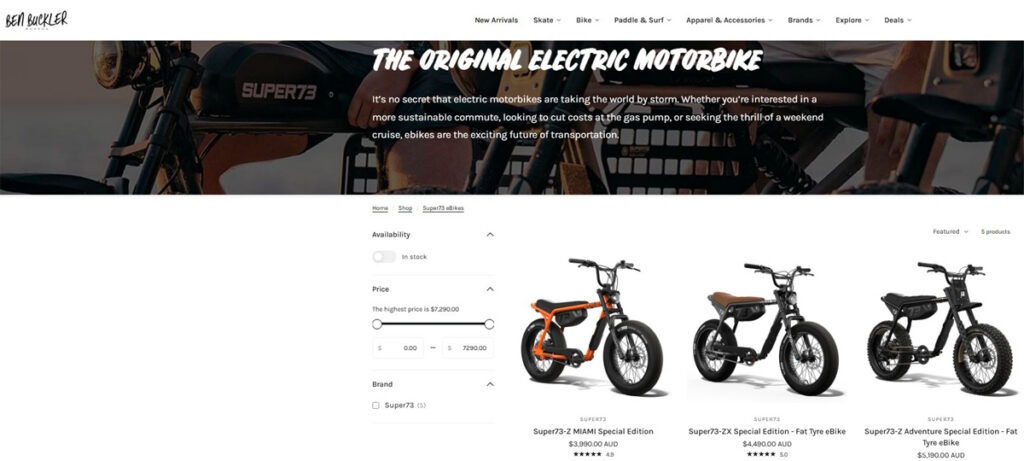
By contrast, the Ben Buckler Boards website shows Super73’s current bikes starting at $3,990 and going up to $7,290. Clearly, just like conventional e-bikes and analogue bikes, there’s also a wide range of specification levels and price points within the fat bike market as well.
Bicycle Industry Australia’s Perspective
Having heard from a fat bike importer, my next logical port of call was the industry association that Ben directly criticised in his comments, to see what their perspective was.
Peter Bourke is the Executive Officer of BIA (Bicycle Industries Australia). As the representative of Australia’s bike industry funded organisation, Peter has probably spent more time attending government hearings, consulting with politicians and speaking to the media about all things e-bike regulation related than anyone else in Australia.
We started with a deeper dive into what exactly the Australian had recently done to reverse the decision of the previous government that opened the floodgates to fat bikes. Just to recap from my previous Stats with Latz article in Flow about Fat Bikes that you can see here, in January 2021 Kevin Hogan, Assistant Minister to the then Deputy Prime Minister Barnaby Joyce, removed e-Bikes from the Road Vehicle Standards Act.
The Federal government has re-added e-bikes to the Road Vehicles Standards Act. But does that mean that importers are required to provide evidence that e-bikes meet the EN15194 (“European Pedelec 25 kph / 250 watt / throttle only up to 6 kph) standard?
“Not quite,” Peter explained. “What it means is that e-bike importers must meet EN15194. But at the moment, it is voluntary. There is no requirement to have an application. Basically it means that if you’re importing an e-bike, there is an assumption that it meets EN15194.
“Only retrospective action, eg complaints, will actually lead to Customs acting.”
So you can still bring in whatever you like?
“Effectively, yes. It could be a customer complaining or anyone else – a coroner or anyone.
Why is the Federal Government not just saying, “An e-bike can’t come into Australia unless it meets the EN15194 standard?”
Peter responded, “Because that would create extra work for the (Federal) Department of Transport and they still believe it is the states’ responsibility to manage e-bikes.”
So have they exactly reversed the step taken in January 2021 by Kevin Hogan or did the government do less than just reverse it?
“No, they reversed it, but there was a second step… Prior to 2021 any importer bringing a bike into Australia needed to make application and prove that they met the EN15194 standard.
“But when the ROVER importation portal was brought in, it went from a mandatory requirement to a voluntary requirement to apply for an advisory notice and that hasn’t been undone in the recent changes.
“If you’re bringing any vehicle into Australia, you must apply for an advisory notice under the ROVER importer portal. Effectively, you had to prove that your e-bike wasn’t a motorbike. They’ve taken away the mandatory element of that and it’s now a voluntary application and it costs something like $54 for two years, so it’s really nothing.
“That’s the next step. They haven’t fixed the problem. They’ve put in place a framework but to the need to shift back to mandatory. They’re missing the key element.
“All of the states are still disappointed by the federal minister’s lack of engagement,” Peter reported.
“They’ve done nothing effective. They can fine people who have brought them in, and that would be our hope that they may actually do that.
“It would be a fine for a false declaration. It’s a declaration by omission. By not applying, an importer is effectively saying that their bikes are compliant. The fine was $8,000 back in 2016. That’s effectively nothing for an importer. I don’t know what it is now.”
I then asked Peter if any importer has received any penalty at all to date.
“No,” he flatly replied. “No-one has received a fine at all. But I am aware that the lack of federal government input was raised at Senate Estimates in February 2026, targeting a specific brand, Fat Boy. So the federal government must come back with a formal written response with what actions they did or didn’t take with that Fat Boy shipment in January 2026, because the question was asked in Senate Estimates.
“That question was asked by Senator Steph Hodgins-May, Senator for Victoria from the Australian Greens.
“Right now, they are doing sweet f-all. But I believe they’re going to be forced to act – by the states.”
Turning to those states, I asked Peter which ones were being the most proactive.
He replied, “New South Wales – that’s for a number of reasons. The parliamentary enquiry in NSW was handed down 12 months ago.
“WA released an enquiry last November. Queensland released their enquiry on Thursday 5th March. Victoria has not done a parliamentary enquiry.”
But parliamentary enquiries are just one tool within the machinations of government. Usually, they make a formal response to an enquiry within three to six months, but sometimes they’re buried forever. An enquiry means no actual changes unless a government legislates those changes.
Peter continued, “Queensland is calling on all e-bike riders to have a motor vehicle licence. We know that Bicycle Queensland, ourselves, the Cerebral Palsy Foundation, Heart Foundation, Multiple Sclerosis Foundation… we’re all going to come out very strongly against this proposal.
“It would mean that anyone who cannot get a drivers’ licence for any reason can never ride an e-bike. Eg someone with a disability, somebody who gave up their drivers for age, someone who lost their licence for speeding, can never ride an e-bike. The Queensland government has not called for responses, but there will be a very large campaign.
“WA has shown in principle support for mandatory licencing and registration of e-bikes and their riders.
A New, Faster Category of E-Bike in Australia?
“One interesting point is that all three states (WA, Qld and NSW) are supportive of a higher powered and higher speed category – eg a Speed Pedelec,” Peter noted. “That would be 45 kph. It would be registered. It would require at licence to ride. It would require a minimum age and it must be ridden on the road.
“I don’t know how that would affect mountain bike riders. Is a mountain bike trail a road or a shared path? (by legal definition)
“The proposed speed pedelec regulations would be taken straight from the current European ones. Their technical designation is L1EV.
“Part of the states’ reasoning for supporting speed pedelecs is that the cat is already out of the bag. There’s already thousands of fat bikes on the road around Australia.
So if people want to use them, this is a way of controlling them. And it helps with the transport network.”
“The Cook Government (WA) has accepted it as one of the recommendations in their report that was tabled on 11th March 2026. But it doesn’t give a timeframe. Neither has Queensland.
“Victoria is also proposing to require a new electrical standard that does not exist anywhere else in the world.
“South Australia, Tasmania, NT and ACT have done nothing.
“Victoria also conducted an enquiry into whether e-bikes could be carried on trains.”
After much publicity and quite strong debate the Victorian decision was to only ban retrofitted e-bikes. Ie standard bikes that have been modified to add an e-bike drive system.
NSW Certification Scheme – High Cost with Dubious Benefits
New South Wales recently implemented an e-bike certification scheme that went into effect from 1st February 2026. The entire program has been an exercise in bureaucratic ineptitude that has cost the bicycle industry millions, restricted choice for consumers and arguably returned little in safety benefits.
Peter explained, “The brands must certify the electrical safety of every model of bike. They must physically certify the charger, the battery, the complete electrical system and the frame.
Therefore, every time you want to certify a bike model, generally it’s two frames that are sent to testing and they’re tested to destruction. You do not get those bikes back.
“This system is designed around certifying a toaster, a hairdryer, where you might be making a million copies of one model.
“Whereas if you’ve got a high end e-bike model and you’re only selling five of that model in NSW, you still have to destroy two bikes. The numbers don’t add up.
“It’s intended to stop battery fires. We’re not opposed to that idea. But the cost is considerable, the volume is not there to recoup the cost and it then needs to be audited by the NSW government or their agent.
“This process is not required anywhere else in the world.
“Secondly, in Australia we have a system called the EESS (Electrical Equipment Safety Scheme). It’s utilised in seven states and territories, but not in NSW! Therefore, other states can’t use the NSW e-bike certification process!”
Testing the battery and electric system is perhaps understandable, although dubious that established international standards and test cannot be simply ratified in NSW, but why destruction test bicycle frames?
Peter answered, “They received advice from the NSW Fire Department that they wanted to have confidence that the frame was strong enough to protect the battery from impact in the event of a crash.
“For bikes that have high volume and minimal number of models (like fat bikes) it’s actually cheaper (per bike sold) for them to get certification.
“We know that some high end bikes have chosen to pull out of NSW.”
Unnecessary Duplication
“The stupid thing from our point of view, and I will call it that, is the lack of understanding within Fair Trading. Even if you have the same motor, the same electrics as the brand next to you, you still have to go and get it tested. As an example, if you have a Bosch CX motor, and the same motor is in a Focus, Yeti, whatever – they all have to go and do their own testing.
“The certification lasts for five years, but only for that model. Once again, a toaster might have the same model for five or 10 years, but they don’t understand that the bike industry it’s not uncommon for every 12 months to have a new model.
“The big problem is, to test it, it had to be a brand new bike, straight out of the box. For bike hire fleets, for high end mountain bikes they may turn over their fleet every 12 months or two years, but when we’re talking about rail trail hire fleets, they quite often last for five years.
“A number of the rail trail hire fleets couldn’t get certified because they couldn’t get their hands on a brand new bike of the same model. So the NSW government was forced to pass an amendment that made hire bikes that were already in the market exempt from the certification process.
“The concern with that is, that meant the food delivery bikes that were the problem (in previous e-bike fires), had become exempt, if the bike was already in the market prior to 1st February 2026. Any bike that is now purchased by a hire company after 1st February must be certified.
“They key is that they did not understand the bicycle sector.”
Save For Fire, But is it Safe to Ride?
Peter continued, “The second part about this which is a significant concern is these products (food delivery bikes) are now being advertised as safe and legal. They are safe and legal to sell.
“Transport for NSW is very much concerned about how they communicate. Electrical certification does not mean legal to use. It means legal to sell. Because they could certify a product that has a 100 kph speed limit or a 10,000 watt motor. It’s not based upon what’s safe and legal to use. It’s based on, “the battery won’t catch on fire.”
“So Transport for NSW and Fair Trading are having significant challenges in that they want to say different things in their consumer communications. Electrical safety say “look for the certification.” Transport says, “don’t rely on the certification.”
“The bike industry is not opposed to what they’re trying to achieve – stopping battery fires. But it has been a disaster financially. We’ve been told that Fair Trading are very disappointed and frustrated that the cheaper brands have been able to get through easier than the better quality brands.
“As at the 1st of February 2026 we estimate that only about 30% to 40% of the e-bikes that were available pre 1st February were still available in NSW. It’s not that the others can’t meet it, or that they’re not safe, it just the cost – estimated at around $10,000 per model.”
Peter’s Predictions – What Will Happen With Fat Bikes In Future?
Clearly the current regulatory situation is a mess. But is there hope for the future?
Peter predicted, “The ACCC (Australian Competition and Consumer Commission) will do something regarding the sale of e-bikes because they believe there’s still a significant concern about what is being made available in the market.
“The federal government, in my opinion, will be forced to act on imports. It may take another 12 months before they do that properly, but they will be forced. The states will make that happen.
“I believe you’ll see that Queensland will be the hardest because they’ve had 13 deaths on e-micromobility in 2025. So they will come down the hardest on these products.
“Unfortunately, there’s already too much product in the market. It will take three years to transition to quality products in my opinion. But we need federal leadership to actually do the right thing. The states are driving it. The feds are pushing back. I believe the states will force them to do something, but it will take a long time.
“They do not have a big lever to pull, but they do have national forum where they meet twice a year. One thing that is positive is that the states are working together to push against the feds.
“The meeting is called ITMM – the Infrastructure and Transport Ministers’ Meetings which is made up of all the state and federal transport ministers. At the August 2025 ITMM meeting they requested that the NTC (National Transport Commission) develop a national position on e-bikes. At the November 2025 ITMM meeting, I believe that the NTC came back with concepts and the states said “Nah, not good enough! We need action.”
“So Kathryn King was, I believe, forced to insert EN15194 (back into the Road Vehicle Standards Act) without actually being ready to do it. Because the states wanted action.
“The NTC is also responsible for developing national road regulations. Then the states generally pull down 95% of those national regulations and they become state road regulations.
“So if we have this conversation this time next year, I’d be confident there’s some progress, but we’ve still got 12 months of pain ahead,” Peter predicted.
Conclusion
I’ve resisted giving personal opinions right through this article, but will finish with a few quite restrained ones.
If you had to lay blame upon a single culprit for the current mess in e-bike regulations it would be at the feet of the federal government. Both major political parties bear equal responsibility as both have the same failings over many years.
They do not take any form of bikes or cycling seriously. The evidence for this ranges from the token levels federal funding for all forms of bike infrastructure over many years, through to not being proactive regarding e-bike regulations and not adequately consulting with all key stakeholders. Inadequate recognition of the bicycle mechanics’ profession and funding of their training is another example.
Therefore, it’s been left to individual state governments to respond to mounting public and media pressure. Images of kids dying and parents weeping are hard for them to ignore. But just like current and past federal governments, there isn’t a single state government in Australia that gives more than platitudes and token levels of funding to bike related infrastructure and activities.
They simply don’t get it. That’s how we can see such potentially discriminatory legislation as Queensland is proposing to require e-bike riders to be sixteen and over and have motor vehicle learner’s permits or full driver’s licences. “Car Brained” is a fair description of the politicians who came up with this bad idea.
Until our elected officials and bureaucrats take all forms of cycling seriously, listen to all stakeholders and develop more thoughtfully crafted responses, you can expect to see more bad decisions and unhelpful legislation, that will cost our bicycle industry members precious time and money. Just ask all the New South Wales based bicycle retailers and national importers who have gone through a very badly thought out e-bike certification program that adds costs but for dubious benefit.
It’s going to be a long, slow process but hopefully, eventually we will have a balanced set of rules and guidelines. Meanwhile for those in the industry who are sticking with EN15194 approved e-bikes, it appears that the current oil shortage is sparking a boost in sales. Let’s hope this gives our Australian bike industry a much needed uptick in profitability. For every cloud, there’s a silver lining!
the multitude of small wheel eBikes are not “fat bikes”.
No matter what the mainstream media may try to tell us. We know better.
I’m not entirely sure Peter Bourke is on top of the e-bike requirements, but perhaps it is the constraints of publishing what is a confusing issue.
Importation. The only power assisted pedal cycle that can be imported without a permit is one that has been determined to be “not a road vehicle”, and this is now defined in “Road Vehicle Standards (Classes of Vehicles that are not Road Vehicles) Determination 2021 (24 Dec 2025)” as being an EPAC meeting EN15194:2017 or later standard. Any other power assisted pedal cycle should not be coming into the country unless it has an advisory notice attached to the import. I recently imported non-assisted pedal tricycles and even though the documentation stated they were not assisted, the import was still challenged. There is certainly awareness in the freight clearance brokers and Australian Border Force.
NSW Certification. The NSW web site covering the e-mobility products broadly lists the standards the product must meet, and the certification process to be followed. The NSW Gazette Number 203 details the actual clauses within the standard that an e-bike must meet. For AS15194 and EN15194 the applicable clauses are 4.2 Electrical requirements, clause 5 Marking and Labeling, and clause 6 Instructions for Use. There is no requirement for the mechanical aspects of the cycle to be tested. Batteries require additional certifications.
The certification process for NSW requires that a comprehensive data package be submitted to either the NSW Fair Trading or a Recognised External Approval Scheme (REAS) organisation. The REAS will review the data and issue a NSW Certificate if they are satisfied the testing has been done to the NSW requirements (plus a $1230 fee of course). My understanding is that there are no test facilities in Australia capable of carrying out the physical EN15194:2017 testing required. The REAS organisations I contacted advised they did not physically test but carried out the review as per the NSW requirements.
The Queensland situation is a total mess, but at least the proposed Bill has been referred back to committee for review. There were some 2500 submissions to the committee as a result of publishing the bill, one analysis I saw of the 110 publicly available submissions had around 95% opposed to the bill! Fingers crossed that common sense prevails.
Interesting you got challenged. We have imported a few containers since the new rules in Jan and have not been asked once about compliance, even though we have the EN15194 reports (which cost us 10s of thousands) ready to hand over as evidence.