Taiwan Bets On 32 Inch MTB’s
It’s been another tough year for the Taiwanese bike manufacturing industry. With things starting to get desperate, they’re piling their chips onto black 32 and crossing their fingers…
Times have been tough for the Taiwanese bicycle industry, which for the past 30 years has been a key supplier of high end bicycles and components to Australia and the rest of world.
Their average unit values of bikes exported have steadily risen. But volumes have fallen dramatically. Each year more production of lower and mid-price level bikes has moved to countries with lower wages including China and Vietnam.
But you’d be very brave to write off the Taiwanese bike industry. They’re extremely hard-working, resourceful people. For example, they’ve invested heavily in new factories and joint ventures lower wage countries, so a significant part of the production that’s now happening elsewhere is still being controlled by and profiting Taiwan.
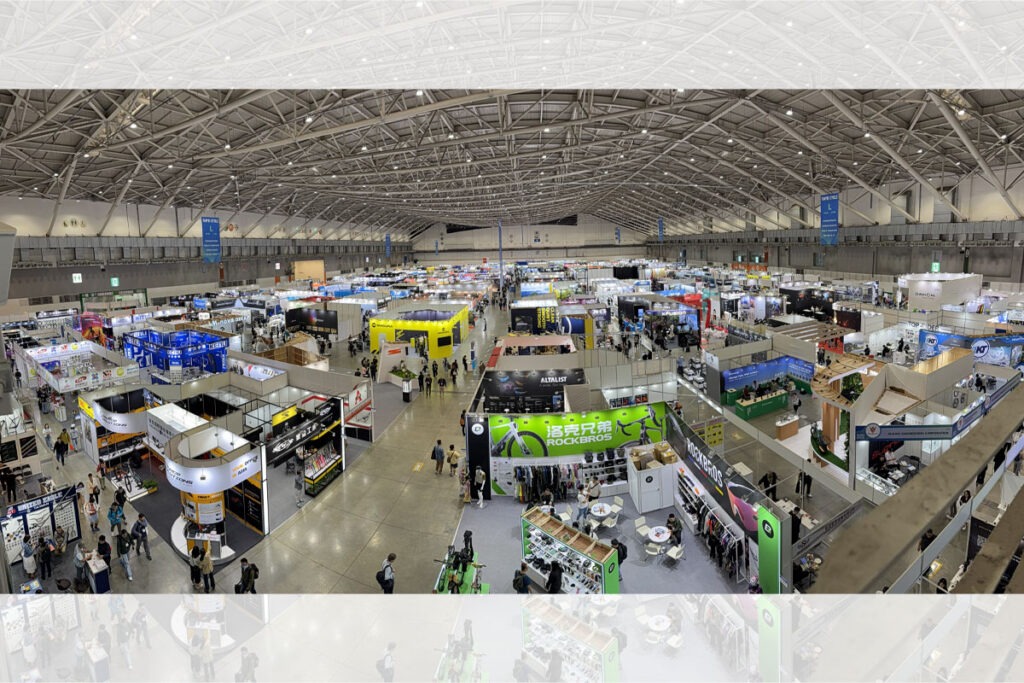
This year’s Taipei Cycle reflected these tough times. It was noticeably smaller and quieter than last year. With the Iran war closing middle eastern airports and causing airfares to rise, quite a few Europeans in particular chose not to make the journey this year. The official post-show press release did not include any attendance numbers – these are usually included in better years.
Ironically, the same Iran war that put a dampener on this year’s show, might also spark an unexpected revival in the bike industry. Just as was the case with Covid, there was initial pessimism in the bike industry, followed by a boom in sales.
At the time of writing, it’s too early to say conclusively, but the latest anecdotal evidence is suggesting that the oil shortages and price surges are sparking a boom in bicycle and e-bike demand. That’s exactly what happened back in the 1973 Arab Oil Embargo, which birthed the “10 speed racer” boom that saw literally tens of millions of cheap road bikes sold in the USA before flaring out after about two years.
Early reports from some Australian importer/wholesalers and retailers, suggest that March was a boom month for some and April month to date is also tracking strongly. But not all wholesalers and retailers are experiencing the same uptick.
Will 32 Inch be the Next Big Thing?
Walking the halls of Taipei Cycle in 2026, it was quickly apparent that multiple companies are betting that 32 inch bikes – mainly mountain bikes, but possibly also gravel – will be the next big thing.
Certainly, they’re physically big, making them stand out at the show. But will the advantages of better rolling characteristics over rough terrain, outweigh the disadvantages including greater weight, greater inertia and slightly slower handling?
The first person to ask about these and other questions was surely David Folch. This very tall USA domiciled Dutchman is the founder of Dirty Sixer. He instigated the movement towards larger wheeled bikes about a decade ago with even more gargantuan 36 inch wheeled bikes and now makes 32 inch bikes. I also spoke with David last year and you can read about that in Flow here.
I started by asking him how it feels to be the instigator of a trend that looks like it’s finally taking off.
“It’s fantastic! he exclaimed. “I mean, I could be pissed that I’ve been working for eight or nine years on developing the 32 and even more on the 36, but you know, everything was so difficult to get tyres, rims, forks. Everything was really hard! And it was lonely.
“But now with 32, it’s really simple. I’m downscaling from 36 to 32. I was banging on doors of tyre, rim, fork manufacturers and everybody was telling me, “No!” But now the doors are opening. Of course there’s a much wider audience for 32.
“I make bikes for tall and heavy riders, so to me, it is a solution that is not for everyone. I see the bike industry as pretty happy to jump into something new. I appreciate the indirect support. All the brands like BMC and maybe Scott, who are the ones who I believe convinced Maxxis to open moulds (for their new 32 inch tyres).
“I opened a mould with Vee Tire a year or two before that, when I learned Maxxis was making a tyre I thought, “Arrgghh! I could have saved some money!”
One contentious aspect of 32’s is whether the standard 110 mountain bike front hub width is adequate for the larger 32 inch wheel. Because as the wheel diameter increases, the degree of lateral triangulation of the spokes as they radiate out from the hub to the rim, decreases. This reduces the lateral strength of the wheel.
“Yes, it’s a big issue,” David said. “The industry is trying to reuse what they already have for 29ers because they don’t want to invest too much money, because they don’t know if 32 is going to stick or not. And it will cost them for tooling to make something that will be safer for 32 than 110mm for the front wheel.
“I’m advocating that they consider 135mm. We used to have 135 mm for fat bikes by Surly a few years ago. It was replaced by 150 mm.
“I’ve used 150 mm front 197 mm rear forever for my 36 inch bikes and now my 32 inch bikes because I have tall and heavy riders.
“I use triple wall rims, 36 spokes and super wide flange to flange hubs. That brings safety and durability to those big wheels.
“If you go 110 mm front and 148 mm or 153 mm rear, there’s going to be problems when people taco their wheels and we’re going to get a bad reputation with that.
“So Novatec, KS, RST, SunTour, all of those fork makers, I’m trying to make them realise that if they do 32 forks with only 110 mm OLD (Over-Locknut Dimension), they’re going to have problems in a year or two because they’re going to have customers coming back saying, “This is too weak!”
“I think we could get away with 177 mm rear, which is another fat bike hub standard.
“But of course, they’re looking at making the lightest and fastest kit possible for the cross country weight weenie races that maybe don’t pay for their bikes.
David concluded, “I am making bikes for six foot 10 inch, 280 pound riders that are NBA players (USA professional basketball) and they have good lawyers… so I prefer to be on the safe side! My customers do not want a bike that will break under their weight or on a long downhill. I want to be able to sleep well at night!”
Meanwhile an employee from a major component supplier, who did not want to be named, made some further comments around 32 inch wheels.
“At least half a dozen brands including Maxxis and Schwalbe have tyres here at the show and I believe Continental and others are working on them,” he said.
“In downhill I think “mega mullets” will be a thing – 32 inch front wheel and 29 inch rear.
“Getting shorter riders to fit on a 32 will be a problem. You might see the size large of a certain model in 32 and the size medium in 29. The logistics of shipping bigger wheels is also a challenge. They don’t fit in standard bike boxes. The ISO wheel testing machines also can’t accommodate 32’s.
“You’re sitting higher off the ground when you ride a 32, but it rides like a normal MTB. Overall an equivalent bike is going to be about 1kg heavier than a 29’er because there’s about 400 – 500 grams extra in the wheelset (bigger rims, tyres and longer spokes) but the fork and the frame also have to be bigger.”
Only time will tell if 32 inch wheels bring real-world benefits to any aspects of mountain biking. If they do, then the Taiwanese bicycle industry might pick up some momentum that it badly needs.
Overall, Taipei Cycle 2026 was a little smaller and quieter than last year. Lower sales have led to smaller research and development budgets and a reluctance to take as much risk on developing new products. But the Taiwanese bicycle industry continues to show resilience and adaptability, so it would be unwise to write it off any time soon.
Photo Highlights

The expo is served by two metro lines and stations – the driverless above ground system that you can see in the foreground and a newer, larger capacity underground line. Both interconnect with Taipei’s extensive metro network. Trains leave every three minutes and only cost about 80 cents per ride. A $15 metro card got me all over the city for four days with credit to spare.

Building 2 for Taipei Cycle is directly across the road, connected by a pedestrian tunnel. Just over a decade ago, this precinct was mainly farmland. It gives you an idea of the economic vibrancy of Taiwan, which is by far the world’s leading manufacturer of high-end computer chips, a business worth trillions of dollars in market capitalisation.

This Sour 32 inch mountain bike is handmade in Dresden, Germany. One of the challenges with such large wheels is how to accommodate anyone other than tall riders, particularly shorter riders.
To keep the handlebars low, this bike uses both the shortest possible head tube and a steeply negative rise head stem. But this also means that the headset top cap is prominently protruding, ready to catch a rider’s face or teeth in a crash.
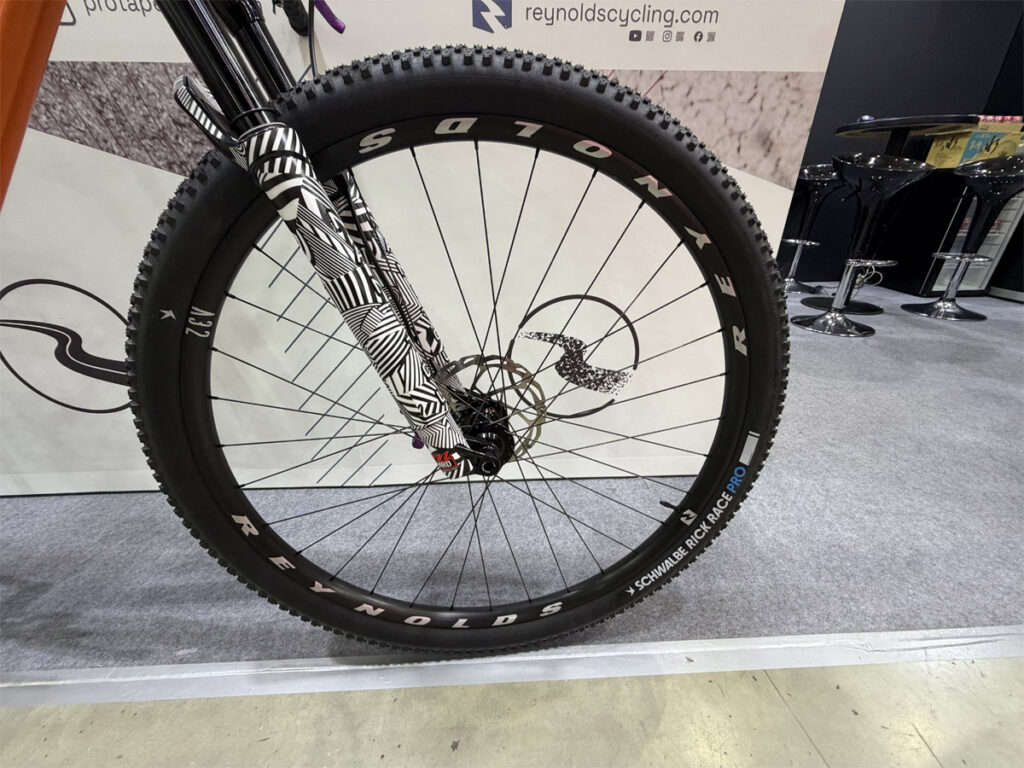
Major component makers are quickly climbing on board the 32 inch bandwagon. The Sour came with Schwalbe tyres, Reynolds rims and a Manitou fork.

David Folch of Dirty Sixer with his latest full suspension 32 inch mountain bike. You can see the extra wide hubs front and rear.


Here’s a further selection of 32 inch mountain bikes that were being displayed this year. The brand names are usually completely obscure because these are from manufacturers who build bikes for other brands. So you might see these coming to Australia under much more familiar brands.
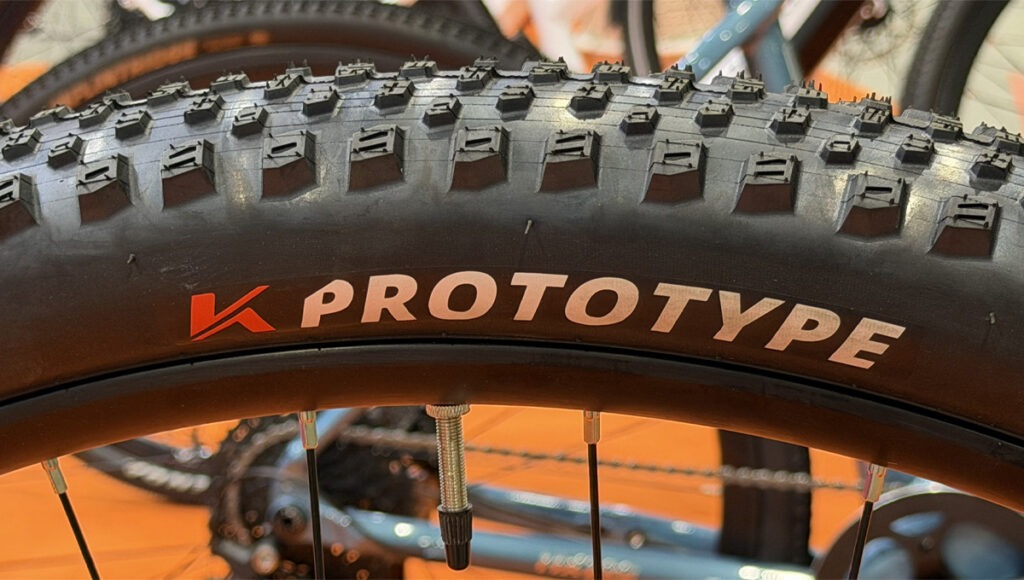
Kenda was one a half a dozen major tyre brands who are getting into offering 32 inch tyres.
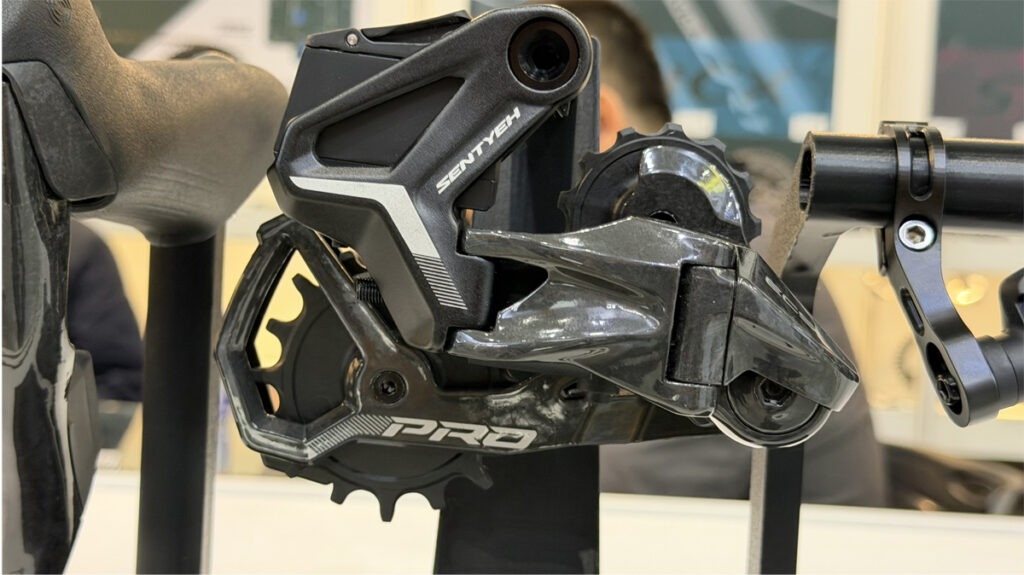
Sentyeh, which was until recently named Sensah, is part of a new wave of Chinese component manufacturers looking to take market share from Shimano and SRAM. The 20 year old company from Guangdong Province in the south of China calls this an “all conditions derailleur,” meaning that in the configuration photographed here, it can be used for road and gravel. But with an exchangeable, longer cage, it can be used for MTB.
They’re looking to compete directly against Shimano Cues, but at a lower price. The representative I spoke with said they’d be working on this derailleur for the past four years and that it took a lot of time to work out how not to infringe on Shimano and SRAM’s patents. It was making its public launch at the show and was not yet spec’d on any bikes.
She said that the company has about 100 staff and so far were only making 1x systems ie no front derailleurs. She said that this derailleur has mainly carbon fibre parts, ceramic bearings and the top section is made from aluminium.
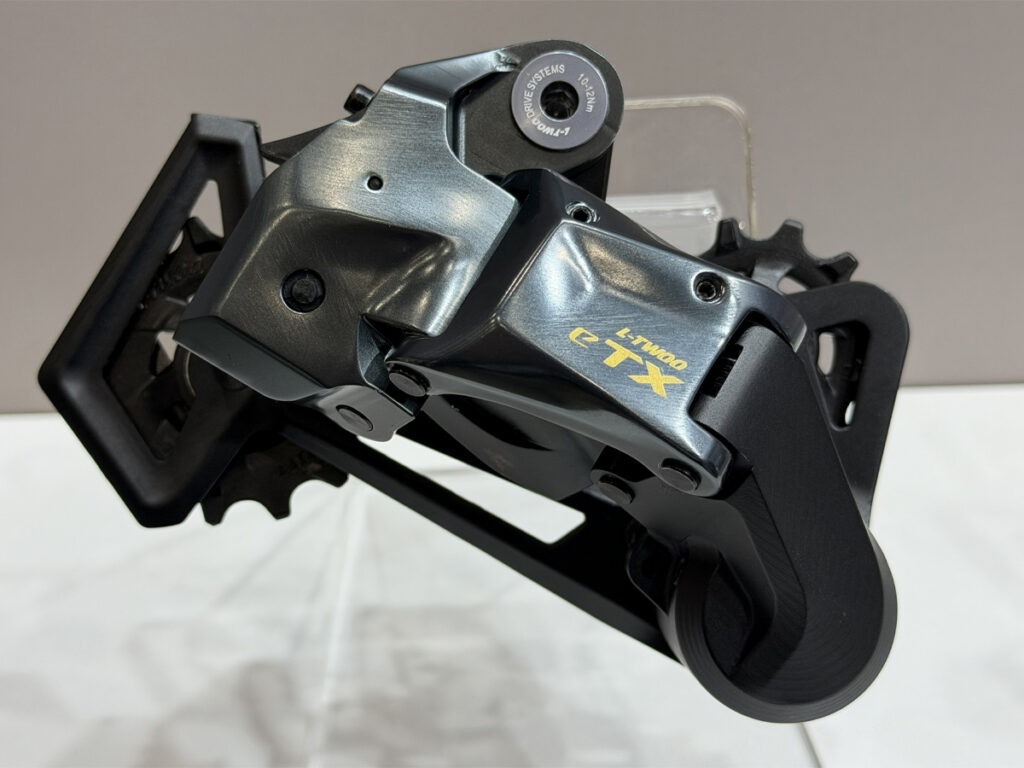
L-Twoo is another Chinese component company that has been gradually launching more refined components.
This ETX mountain bike derailleur features both a mechanical and hydraulic clutch. Their representative said that the same derailleur can be configured for use on 10, 11 and 12 speed cassettes by adjusting it via an app. They said that this was a new model, going on sale from May 2026 and not yet spec’d on any bikes.
It’s part of a wireless electronic 1x system, made from aluminium and weighs 425 grams, (I think including the battery) which is significantly more than high end Shimano rear derailleurs.

These 2 piston and four piston versions of L-Twoo’s hydraulic brakes feature one piece CNC machined brake callipers. L-Twoo is about to be launched into Australia via a new distributor, Quality Components being co-founded by Australian MTB retail pioneers Fraser Wilkinson and Simon Jamison.

Not all 32’s will be mountain bikes. This is the A&J Terra32 gravel bike, it features a carbon fork, allow frame and SRAM wireless groupset.

This is a new gravel-specific air fork from XFusion. It weighs 1,340 grams and has options for 30 mm, 40 mm and 50 mm travel with lockout, rebound and air spring adjustments.

This new Coreflow tubeless valve is designed to allow up to 500% more air volume and also lets sealant flow more easily into a tubeless tyre.

Bike cleaning products and lube company Muc Off launched their new Dark Energy chain wax at Taipei Cycle. It seems like waxing chains is another idea that’s moving to the mainstream.

KMC is possibly the world’s largest bicycle chain manufacturer, making not just their own branded chains but most of Shimano’s chains as well.
They were heavily promoting the Go Wax system that includes both waxes and pre-waxed chains.

I’ve written about Retyre previously but this Norwegian-based company is about to reach a critical milestone. Retyre tyres are injection moulded using a range of compounds that contain no rubber at all. Until now they’ve had capacity to make about 20,000 tyres per year, but they’re about to construct two “production cells” each capable of making 1.6 million tyres per year. Each takes about 500 square metres of factory floorspace, which is a small fraction of the space that would be required for conventional tyre manufacturing.
Production will be fully automated, allowing it to be cost-competitive in the super high wage country of Norway.

This is a sample mould for a Retyre tyre. Unlike conventional tyres, protype tyres can be quickly and cheaply developed using 3D printing to make them individually. Then they can make small run moulds like this white one from resin using a 3D printer.
Production moulds are made from steel.
Rather than competing with existing tyre brands, Retyre plans to offer its services to a wide range of tyre companies and they’re already working with Vittoria and others.

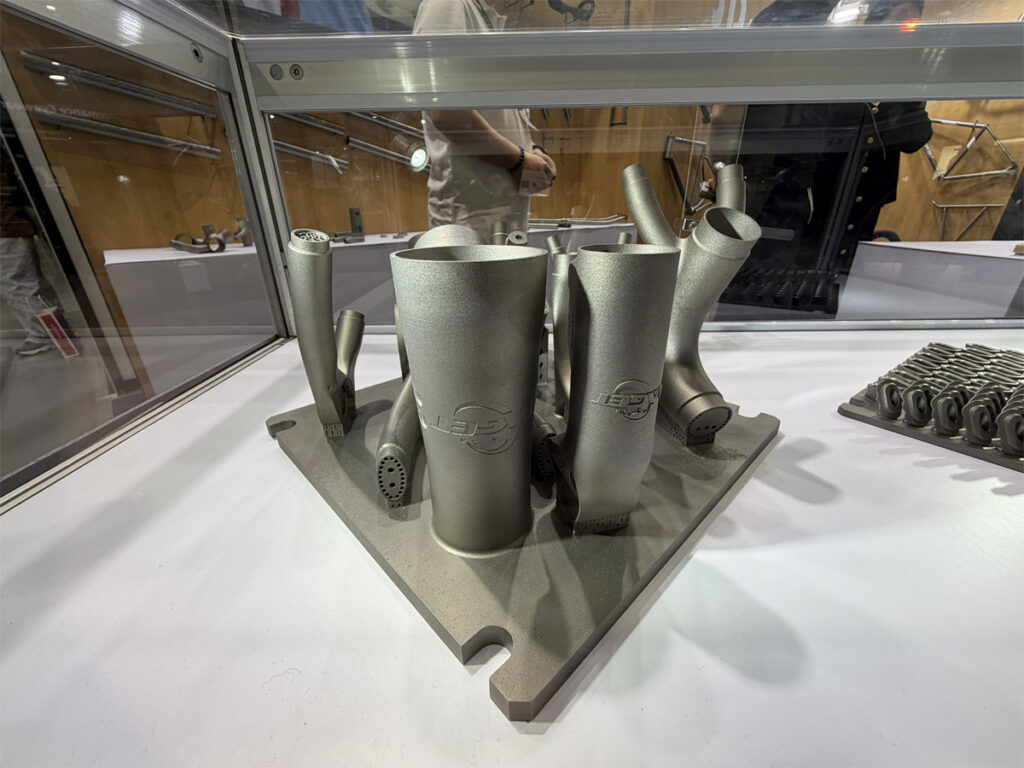
The initial hype around 3D printing in general and the promises of low cost, low weight, high quality 3D printed bicycles and components has died down over recent years, but just like most other new innovations that go through a “hype cycle”, 3D printing is here to stay and gradually becoming more refined and widespread.
This bike frame was entirely 3D printed and you can see how they make individual tubes and frame components looking at the unfinished parts in the second photo. They’re yet to be cut from their base plate and receive final machining.

By moving the black pin into one of the three labelled positions, this cassette spanner can perfectly fit cassettes with either a 10, 11 or 12 tooth smallest cog.

Currently a marketing gimmick, this backpack features two animated LED screens, so that they eyes were programmed to blink and scan across from left to right. You can imagine the same technology being used for turning indicator lights or other safety features and being integrated in to bike bags or other items.

These local guys have taken their passion for the iconic Italian Bianchi brand to a whole new level. These 40-50 year old road bikes were as original, complete and immaculate as you could ever hope to see.

Rob Gitelis co-owner of Factor Bikes said that this Bugatti bicycle was not just a licencing deal with the iconic sports and racing car manufacturer, but a technical collaboration. Only 250 bikes were produced in a limited edition numbered series for a retail price of US$25,000 (A$34,916) each. Rob said the bikes are almost completely sold out after a short on sale window.

This is Eddy, founder of Microlite reflective streetwear clothing. Far from being a new novelty, Eddy says he’s been in business for 48 years and currently employs 70 staff, who make reflective fabric and do the cutting and manufacturing. The reflective material is made from glass bead. His company also supplies reflective material to bicycle tyre manufacturers.

Founder of Giant Bicycles, King Liu passed away just before Taipei Cycle at the age of 91. Giant had this tribute to him on their stand, that also included a very interesting video showing highlights of his long career.
In 2007 at the age of 73, King rode this bicycle approximately 1,000 kilometres around the island of Taiwan – a remarkable feat that birthed a major annual ride including many of Taiwan’s bicycle industry owners and leaders.
King was also a strong cycling advocate, special cycling advisor to the President of Taiwan and a key player in Taiwan’s highly successful nationwide YouBike bike share system.
He took Giant from a tiny start up in 1972 through to becoming one of the world’s largest bicycle companies by the time of his retirement in 2016 at the age of 81.
His legacy is continuing via members of the Liu family who continue to hold key positions in Giant Bicycles, which is now a publicly listed company trading on the Taiwan Stock Exchange.

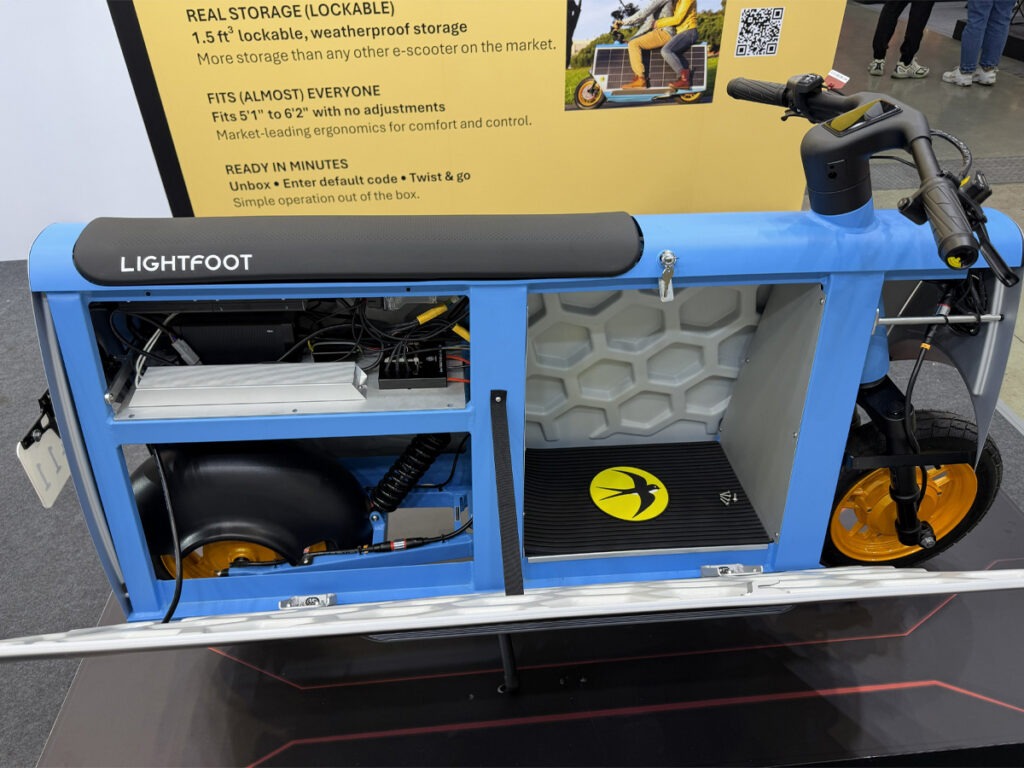
Is this something that a bike shop should sell?
These two photos show the Lightfoot Solar scooter, that has been designed by high profile Australian engineer and activist Saul Griffiths, who attended Taipei Cycle this year.
The Lightfoot is designed to replace car trips of under 10 kilometres. It has a 75 kilometre battery range, to which sunshine can add 50 kilometres of range per day, weather permitting. It also features regenerative braking and 45 litre capacity of waterproof, lockable cargo space. It’s making its retail debut in the USA for US$4,999 (A$6,981).
Saul is working on how to sell this bike in Australia, where current regulations may cause issues.

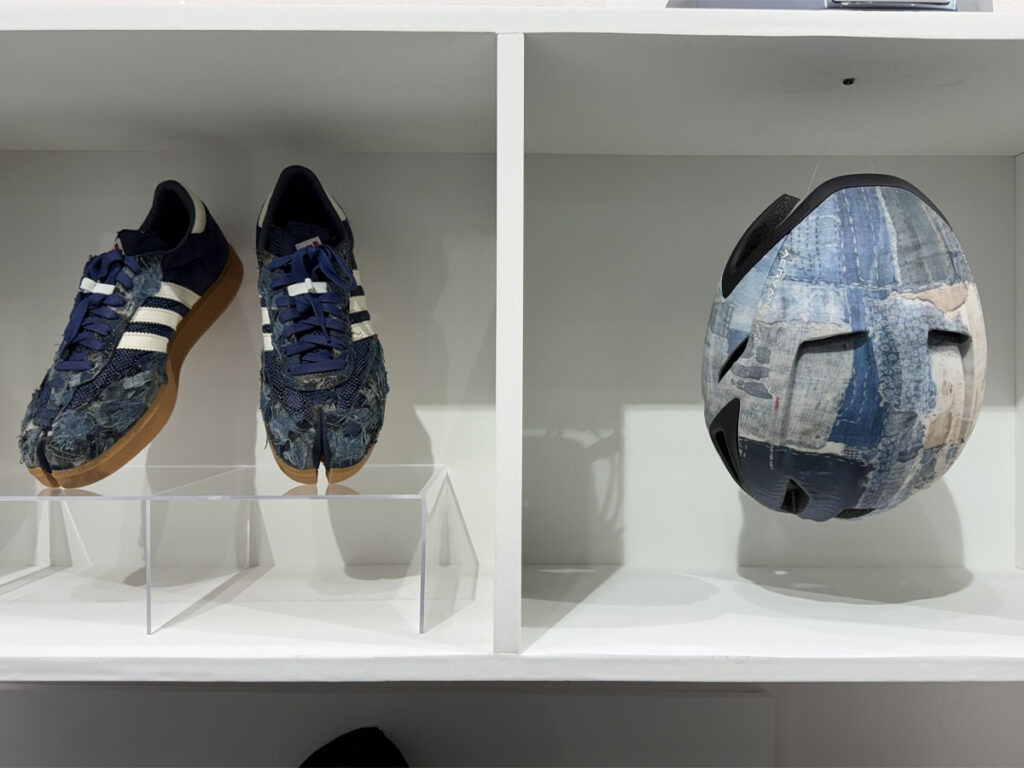
Japanese Tabi is a traditional form of footwear featuring a split toe design. This stand displayed an interesting design and colour style collaboration between Rifare Co and Trigon bicycles.